


MUJERES EN EL ARTE, LA CIENCIA
Y LA TECNOLOGÍA
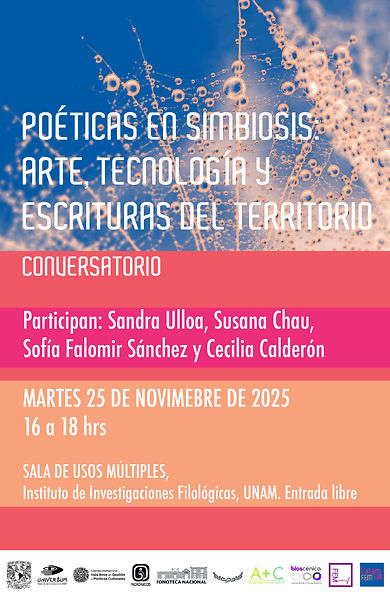
del 25 al 29 del noviembre 2025
Como parte de la red internacional FEMeeting: Women in Art, Science and Technology, se llevará a cabo el encuentro LatamFem Lab 2025 en noviembre de 2025 organizado por
María Antonia González Valerio, Lena Ortega Atristain y Minerva H. Trejo, en colaboración con el grupo de investigación y creación Arte+Ciencia de la UNAM y Bioscénica: cuerpo digital y transdisciplina.
LatamFemLab 2025 busca consolidar y ampliar una red de colaboración que permita el intercambio de proyectos transdisciplinares en la intersección de arte, ciencia y humanidades.
A partir de esta sinergia, se fomentarán iniciativas que respondan a los desafíos contemporáneos desde una perspectiva crítica e innovadora, desafiando los saberes tradicionales y promoviendo enfoques que dialoguen con las realidades sociales, políticas, tecnológicas y culturales contemporáneas.
En esta primera edición participamos:
Ale de la Puente, Amanda Gutiérrez, Andrea Robles Jiménez, Anni Garza Lau, Berenice Olmedo, Cecilia Delgado Masse, Cinthya García Leyva, Claudia Arozqueta, Cynthia Villagómez, Deborah Dorotinsky, Edith Medina, Edith Vázquez, Eurídice navi,
Eva Hernández, Gabriela Aceves-Sepulveda, Gemma Argüello, Ilana Boltvinik, Julia Carrillo, Laura Balboa, Leena Lee, Leslie García, Lorena Mal, Lucía Rodríguez, MAGENTA,
Malitzin Cortés, María Antonia González Valerio, Melissa García Aguirre, Minerva H. Trejo, Monica Nepote, Myriam Beutelspacher, Paola Everardo, Paz Sastre, Rossana Lara,
Sandra González Santos, Sandra Romero, Sandra Ulloa, Sofía Falomir, Susana Chau,
Tania Aedo, Tania Ximena y Viviana Díaz.
A partir de este primer lanzamiento queremos invitar a mujeres en Latinoamérica a sumarse a la segunda edición.
EVENTOS


NOTICIAS/NEWS
ALGUNOS DE NUESTROS MÁS RECIENTES TEXTOS, PIEZAS Y PLÁTICAS EN LÍNEA/SOME OF OUR MOST RECENT TEXTS, WORK AND
ONLINE TALKS
ESPACIOS DE RESISTENCIA
“Espacios de resistencia. Catálogo inexacto de la naturaleza en los bordes de una ciudad” es un proyecto de Arte+Ciencia y Bios ex Machina que reflexiona sobre los modos de ser de la naturaleza en los enclaves citadinos. Busca comprender nuestro trato con el entorno desde una perspectiva crítica que cuestiona la historia de la urbanización de la Ciudad de México.
La naturaleza se da en un diálogo continuo con el urbanismo, donde las negociaciones han dependido de diferentes ejes de organización, siendo lo agrícola y lo vehicular sus principales coordenadas. La ciudad se ha transformado infinidad de veces, y su crecimiento se ha desbordado más allá de los márgenes que en algún momento fueron considerados como fronteras geológicas naturales, así: el pedregal de San Ángel.
El territorio de la Cantera oriente, parte de la Reserva Ecológica del Pedregal de San Ángel (REPSA) que administra la UNAM, ha servido como eje de reflexión para realizar un trabajo de campo en el que se exploran diferentes (des)apariciones de la naturaleza en un entorno citadino, así, el sonido (de máquinas y aves), el agua (los lagos en la Cantera emergieron cuando la excavación de la zona llegó al manto freático), los suelos (como sustrato de crecimiento pero también como receptáculo de residuos, pues la Cantera alberga parte del escombro del sismo de 1985), los animales silvestres (¿dónde está lo animal en la ciudad?), etc.
La exposición y el programa público tuvieron lugar en el Centro Cultural de España en México entre marzo y junio de 2023.
SPACES OF RESISTANCE
"Spaces of resistance. Inaccurate catalog of nature on the edges of a city" is a project of Arte+Ciencia and Bios ex Machina that reflects on the ways of being of nature in urban enclaves. It seeks to understand our dealings with the environment from a critical perspective that questions the history of urbanization in Mexico City.
Nature is in a continuous dialogue with urbanism, where negotiations have depended on different axes of organization, being the agricultural and vehicular its main coordinates. The city has been transformed countless times, and its growth has overflowed beyond the margins that, at some point, were considered natural geological boundaries, such as the pedregal of San Angel.
The territory known as “Cantera Oriente”, part of the Ecological Reserve of the Pedregal de San Ángel (REPSA) administered by the UNAM, has served as the axis of reflection to carry out fieldwork in which different (dis)appearances of nature in a city environment are explored.
The exhibition was at Centro Cultural de España en México in 2023.


NEW BOOK
This book offers intriguing philosophical inquiries into biotechnological art and the life sciences, addressing their convergences as well as their epistemic and functional divergences. Rooted on a thorough understanding of the history of philosophy, this work builds on critical and ontological thought to interpret the concept of life that underscores first-hand dealings with matter and experimentation. The book breaks new ground on the issue of animality and delivers fresh posthumanist perspectives on the topics addressed. The authors embark on a deep ontological probe of the concept of medium as communication-bridging and life-bearing. They also take on the concept of performativity as biotechnological art. The book includes concrete, well-documented case studies and shows how certain narratives and practices directly impact ideas surrounding science and technologies. It will interest philosophers in art and technology, aesthetics, ontology, and the life sciences. It will also engage art practitioners in art and science, curators and researchers.

NUEVO LIBRO
Sólo mediante un ejercicio dudoso de análisis podemos pensar en la humanidad desnuda, despojada de todas las mediaciones técnicas que se han confundido con su piel. El punto cero del cuerpo humano, más que una verdad autoevidente, es un mito, gesto mitológico de la metafísica. La desnudez es un efecto óptico al que llegamos sólo tras ocultar las capas que la han construido. Lo técnico no es un añadido a lo humano, sino uno de los medios por el que nos abrimos a la alteración; nos ubica y dispone en lugares distintos para vincularnos con lo familiar, lo nunca visto y lo que no puede entenderse sin su mediación. Por ello es que podemos contar, atendiendo a las mediaciones artefacturales, las historias de los órganos, de la mente, de los lazos sociales, de las interacciones entre especies e incluso la comprensión del tiempo y del espacio. Así, un pensamiento riguroso demanda entender los modos de ser de estas mediaciones y las determinaciones que emergen gracias a su intervención. En este volumen pretendemos hacer lo propio en el campo de la estética, y para ello discutimos conceptos básicos de la ontología, distinciones tradicionales entre arte y artefacto y analizamos obras artísticas concretas.
HERE IS OUR NEW BOOK
Only through a dubious analysis exercise can we think of humanity naked, stripped of all the technical mediations that have become confused with its skin. The zero point of the human body, more than a self-evident truth, is a myth, a mythological gesture of metaphysics. Nudity is an optical effect to which we arrive only after hiding the layers that have built it. The technical is not an addition to the human but one of the means by which we open ourselves to alteration; it places and arranges us in different places to link us with the familiar, the unseen and that which cannot be understood without its mediation. This is why we can tell, by attending to artifactual mediations, the stories of organs, the mind, social bonds, interactions between species, and even the understanding of time and space. Thus, rigorous thinking demands an understanding of the ways of being of these mediations and the determinations that emerge thanks to their intervention. In this volume, we intend to do the same in aesthetics. For this purpose, we discuss basic ontology concepts and traditional distinctions between art and artefact and analyse concrete artistic works.


TEXTOS RELACIONADOS CON EL COVID-19/
TEXTS COVID-19 RELATED
https://www.eluniversal.com.mx/maria-antonia-gonzalez-valerio-y-rosaura-martinez-ruiz
https://ctjournal.org/2020/05/05/triage-deciding-the-ethically-undecidable/
https://www.filco.es/covid-19-critica-en-tiempos-enfermos/
https://transversal.at/blog/covid-19-critique-in-sick-times
https://pensarlapandemia.com/2020/04/14/covid-19-un-tranvia-sin-frenos/
https://www.educacionfutura.org/en-el-vientre-de-la-ballena/
LÍNEA ACTUAL DE INVESTIGACIÓN/
CURRENT LINE OF RESEARCH
El espacio como concepto filosófico ha pasado por importantes cuestionamientos y ha llegado a adquirir centralidad en los debates contemporáneos. Desde la historia de las ideas, podríamos analizar las condiciones de emergencia del reposicionamiento de este concepto. Habría cuando menos dos condiciones fundamentales: la interrogación sobre el espacio matemático, su continuidad y extensión; y el resquebrajamiento de la subjetividad, a la cual el espacio pertenecía como parte de la posibilidad de comprensión del mundo.
Ni espacio matemático, ni subjetivo, es decir, ni algo cuantificable y divisible, ni tampoco algo vacío como mera estructura; la reconsideración del espacio como categoría ontológica ha implicado volverlo a ligar al tiempo, temporizarlo, hacerlo el resultado de interrelaciones y de una construcción constante. El espacio no está meramente allí, sino que viene a ser, es abierto y se constituye también según las entidades que en él se dan.
Si la idea de espacialidad había excluido la temporalidad, se trata de ahora entender el movimiento, la historización y la temporalización de lo que parecía neutro, vacío y simplemente dado. El espacio está investido, no es un a priori y es algo que se construye por negociaciones; el ámbito de lo político es en esto ineludible.
Desde la propuesta de filosofía natural que estamos siguiendo, pretendemos pensar el espacio en la temporalización tomando como horizonte de reflexión la ecología y la evolución. Buscando tener una aproximación más específica a la materialidad concreta, hemos de abrir el tema del espacio acotándolo en términos evolutivos y ecológicos para pensar la relación condicionado-condicionante en la espaciación, esto es, de qué modo los organismos vivos condicionan el ambiente, al tiempo que éste es condicionado por aquéllos.
En el contexto de la renovación de las discusiones académicas sobre “evolución de las especies”, la importancia de los organismos como sistemas integrados que se desarrollan ontogenéticamente –es decir, despliegan complejidad estructural y funcional conforme crecen a lo largo de su tiempo de vida– y que responden plásticamente al ambiente que ellos mismos modifican con sus propias actividades, resultan centrales. Dentro de la estructura teórica en ciernes que representa la “Síntesis Evolutiva Extendida”, la noción de reciprocidad causal entre organismo(s) y ambiente(s) y su concepto complementario –según el cual el desarrollo ontogenético es en sí mismo constructor de los detalles estructurales/funcionales del organismo (ya que éstos no se encuentran ‘codificados’ exhaustivamente en el genoma)– se siguen perfeccionando a través de conjuntos de investigaciones, en las que hemos de incluir la idea de espaciación para replantear la relación condicionado-condicionante.
También incorporaremos la idea de construcción de nicho, pues nos permite hacer preguntas concretas en relación al papel que los organismos juegan en la producción de su espacio y cómo está directamente relacionado con el proceso adaptativo y con la herencia ecológica.
Lo anterior se engarza con las discusiones en el mundo del arte. En el siglo XX las nociones evolutivas de selección y mutación se incluyen en fórmulas artísticas que replantean la configuración de espacios y su intervención más allá de las limitantes del museo y la galería. Hay que tematizar explícitamente el espacio y el medio como materiales propios de la plástica.
CURRENT LINE OF RESEARCH
Space as a philosophical concept has gone through important questionings and has acquired centrality in contemporary debates. From the history of ideas, we could analyze the emergency conditions of the repositioning of this concept. There would be at least two fundamental conditions: the questioning of mathematical space, its continuity and extension; and the cracking of the subjectivity, to which the space belonged as part of the possibility of understanding the world.
Neither mathematical nor subjective space, that is to say, neither something quantifiable and divisible, nor something as a mere structure; the reconsideration of space as an ontological category has implied to link it back to time, to temporize it, to make it the result of interrelations and in constant construction. The space is not merely there, but it comes to be, it is open and it is also constituted according to the entities that occur in it. If the idea of spatiality had excluded temporality, it is now a matter of understanding the the movement, historization and temporization of what seemed neutral, empty and simply given. Space is invested, it is not an a priori and it is something that is built through negotiations; the political sphere is inescapable.
From the proposal of natural philosophy that we are following, we intend to think the space in temporization with ecology and evolution as the horizon for reflection. Seeking to have a more specific approach to concrete materiality, we have to open up the subject of space and frame it in evolutionary and ecological terms in order to think about the relationship conditioned-conditioning in spacing. This is, in what way living organisms condition the environment, at the same time as it is conditioned by them. In the context of the contemporary academic discussions on the “evolution of the species” the importance of organisms as integrated systems that develop ontogenetically —that is, they unfold structural and functional complexity as they grow throughout their lifetime— and that respond plastically to the environment in which with their own activities, are central. Within the theoretical structure which represents the “Extended Evolutionary Synthesis”, the notion of causal reciprocity between organism(s) and environment(s) and their complementary concept —according to which development ontogenetic is itself constructor of the structural/functional details of the organism (since these are not 'coded' exhaustively in the genome)— needs to include the idea of spacing so as to rethink the conditioned-conditioning relationship. We will also incorporate the idea of niche construction, because it allows us to ask questions in relation to the role that organisms play in the production of their space, and how it is directly related to the adaptive process and ecological heritage. This is linked to discussions in the art world. In the twentieth century notions of selection and mutation are included in artistic formulas that rethink the configuration of spaces and their intervention beyond the limits of the museum and the gallery. Space and the medium must be explicitly thematized as plastic materials.